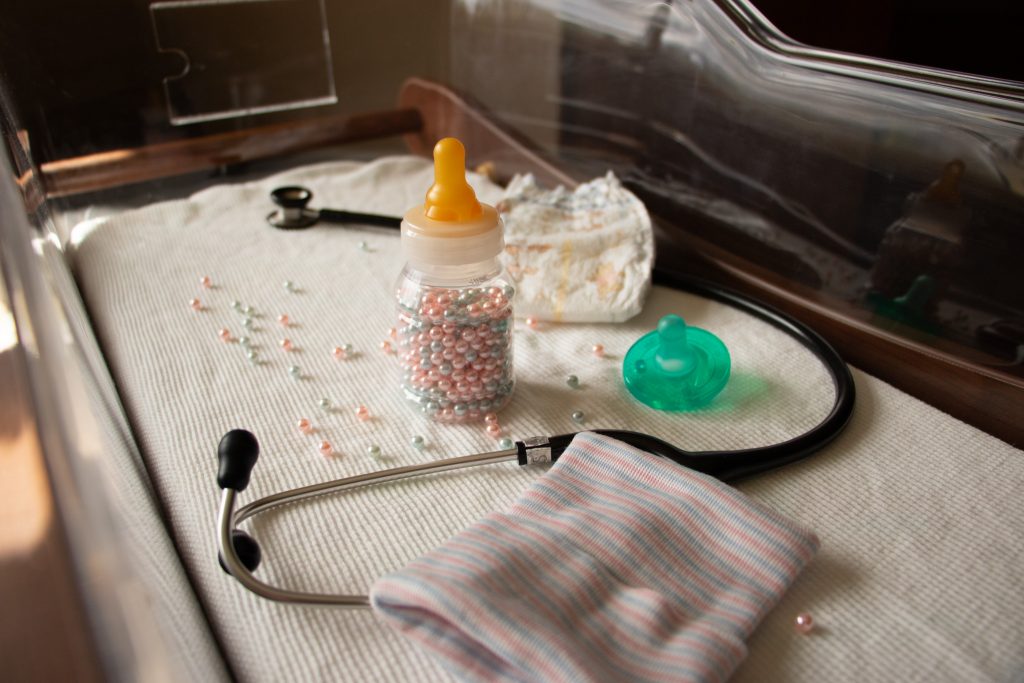
May 6th, 2026 —In the labor and delivery unit at Madison Regional Health System, you’ll find a display of beads. Each time a mother and her newborn prepare to go home, they drop in a bead—blue for a boy, pink for a girl. Over the past decade, approximately 500 beads have accumulated. Each one represents a birth that happened close to home, in a community hospital that chose to keep its labor and delivery department open.
This month, Madison Regional marks one year using Epic’s electronic health record and MyChart patient portal—and with it, pauses to reflect on what that year has meant for the families it serves. Approximately 50 babies have been born at Madison Regional in that time. The Epic investment is one signal of a broader commitment: to provide the kind of care that keeps rural communities whole, starting at the very beginning.
“Investing in Epic was a statement of intent,” said Teresa Mallett, Chief Executive Officer of Madison Regional Health System. “We are here. We are building. And we intend to be here for the next generation of families in this community.”
L&D in Rural America
Rural labor and delivery units are closing across the country at an alarming rate. Across the United States, one in four rural hospitals has closed its obstetric unit since 2010, and as of 2022, more than half of rural hospitals offered no obstetric services at all, according to a 2025 study on obstetric care access.¹ When those units disappear, the nearest delivery hospital moves, on average, 29 miles further away, according to a 2024 National Rural Health Association report.² Distance matters. Research cited in the same report found that women who must travel 45 minutes or more to deliver are more than one and a half times as likely to experience premature birth than those who can reach care in under 15 minutes.²
Madison Regional has seen these trends and chosen a different path.
“Women in labor are going to show up at our doors no matter what,” said Mallett. “The question is whether we’re ready for them. We’ve decided the answer will always be yes.”
A Community Commitment, Backed by Technology
“When a mother walks through our doors, we can often see her health history before she says a word,” said Dr. Laura Hoefert, who provides OB care at Madison Regional. “And every baby born here leaves with a health record already in place, ready to follow them wherever life takes them. That continuity of information can inform care for years to come.”
Epic gives Madison Regional’s physicians visibility into the health histories mothers bring with them—records from other providers, prior pregnancies, existing conditions—from the moment they walk through the door. In a rural setting, where patients may travel from across a wide region and receive care from multiple systems, that complete picture can be the reason a complication is avoided.
The difference is immediate and practical for bedside staff. When a mother comes in and her baby needs attention, the care team does not need to piece together separate records from different corners of the system. Mom’s chart and baby’s chart are side by side.
“In those moments, you don’t want to hunt for information,” said Beth Graff, OB nurse manager at Madison Regional. “Having everything in one place means we can give the patient our full attention. When you’re here, you’re our priority.”
How Madison Regional Makes It Work
Keeping a rural labor and delivery unit open requires deliberate choices. Madison Regional prioritizes hiring family medicine physicians trained in obstetric care—physicians who can cover broad clinical ground and flex into L&D when needed. Nurses are cross-trained across departments for the same reason. Equipment investments ensure the unit is prepared for the unexpected. Patients also find something they might not expect: a preference for the intimacy of a small hospital. In Madison Regional’s L&D ward, no patient is just another patient. A mother may have the ward largely to herself, cared for by nurses who know her name.
While labor and delivery is rarely a financial driver for a hospital of this size, Madison Regional sees it as something else: the beginning of a lifelong relationship with a family in this community.
“These are our neighbors,” said Graff. “We want to be there when their children are born, and we want to still be here as those children grow up. That’s what it means to be part of this community.”
Across our region, moms are expecting. There will be more blue beads. And more pink ones. Madison Regional Health System will be here for them.
# # #
¹ Obstetric Care Access Declined in Rural and Urban Hospitals Across US States, 2010–22 (2025), as cited by the Rural Health Information Hub, ruralhealthinfo.org.
² National Rural Health Association, Maternal Health in Rural America (February 2024). The premature birth finding cites an underlying study of pregnant women in Georgia examining drive time to delivery hospital.